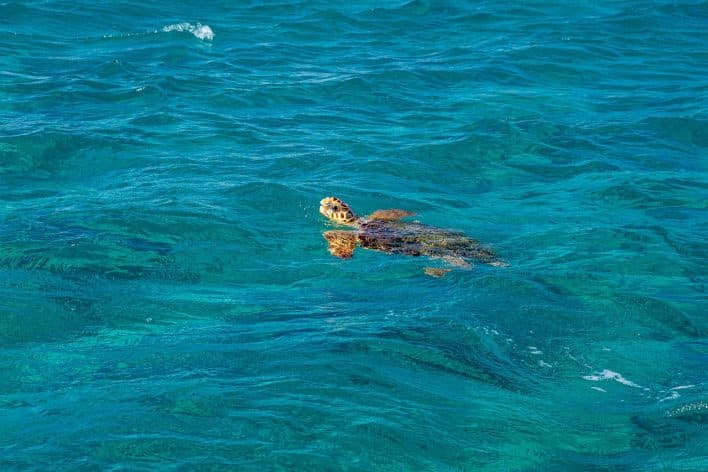
The turtle you see in Kefalonia and across Greece is the loggerhead, Caretta caretta. It is the most common sea turtle in the Mediterranean and the only species that nests in large numbers on Greek beaches.
What is a loggerhead turtle?
The loggerhead takes its name from its unusually large head and strong jaws, which it uses to crush shellfish and crustaceans. Adults have a reddish-brown, heart-shaped shell and are powerful, long-distance swimmers.
How big do loggerhead turtles get?
Adults typically reach about 0.9 to 1.2 metres in shell length and can weigh anywhere from around 100 kg to well over 150 kg, with exceptional individuals heavier still.
How long do they live?
Loggerheads are long-lived, commonly reaching 50 years or more. They mature slowly, often not breeding until their twenties or thirties, which is one reason the species is so vulnerable.
What do loggerhead turtles eat?
They are mainly carnivorous, feeding on crabs, molluscs, jellyfish and other invertebrates. Their strong jaws let them crush hard shells that few other animals can.
Why are they protected?
Caretta caretta is classed as vulnerable. Coastal development, fishing bycatch, plastic pollution and beach disturbance all threaten nesting. In Greece, groups such as ARCHELON and Wildlife Sense protect nests and study the population. You can help simply by watching responsibly, which we cover in our responsible viewing guide.